
Your body clock resets with light
Your body runs on a roughly 24-hour internal rhythm, the circadian rhythm, that influences when you feel alert and when you feel sleepy. It isn't exactly 24 hours, so it needs a daily nudge to stay in sync with the outside world. Light reaching your eyes is the strongest of those signals.
Timing matters. In general, light in the morning tends to shift the clock earlier, and bright light late in the evening tends to shift it later. That's why sleep researchers usually recommend plenty of daylight early in the day and dimmer light at night.
Daylight is much brighter than indoor light
Brightness is measured in lux. A typical living room or office sits somewhere around a few hundred lux. An overcast sky outdoors is usually in the thousands, and direct sun can reach tens of thousands. So even a grey morning outside is many times brighter than a well-lit room.
That's also why a window helps more than a lamp, and outside helps more than a window.
What this does and doesn't mean
Morning light is one helpful habit among several, alongside a regular sleep schedule and a darker, calmer evening. It isn't a cure for anything. If you have ongoing problems with sleep or mood, talk to a doctor. Skyshot is a wellness alarm clock, not a medical device.
And never look directly at the sun. You only need to be in daylight, facing the sky in general.
Easy ways to get morning light
The best routine is one you'll keep. A few options:
- Step onto a balcony or front step for a few minutes after waking.
- Have breakfast or coffee by the brightest window.
- Walk part of your commute, or get off a stop early.
- In winter, when it's still dark, open the curtains and catch the first light when it comes.
Where Skyshot fits
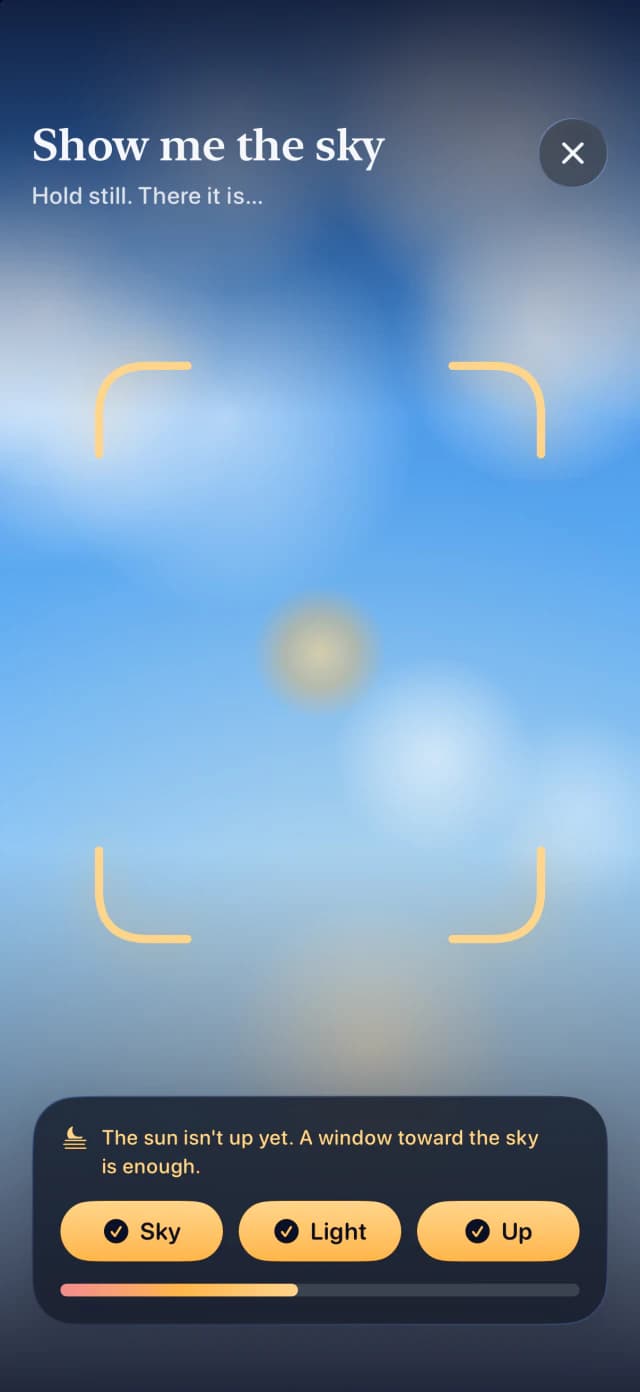
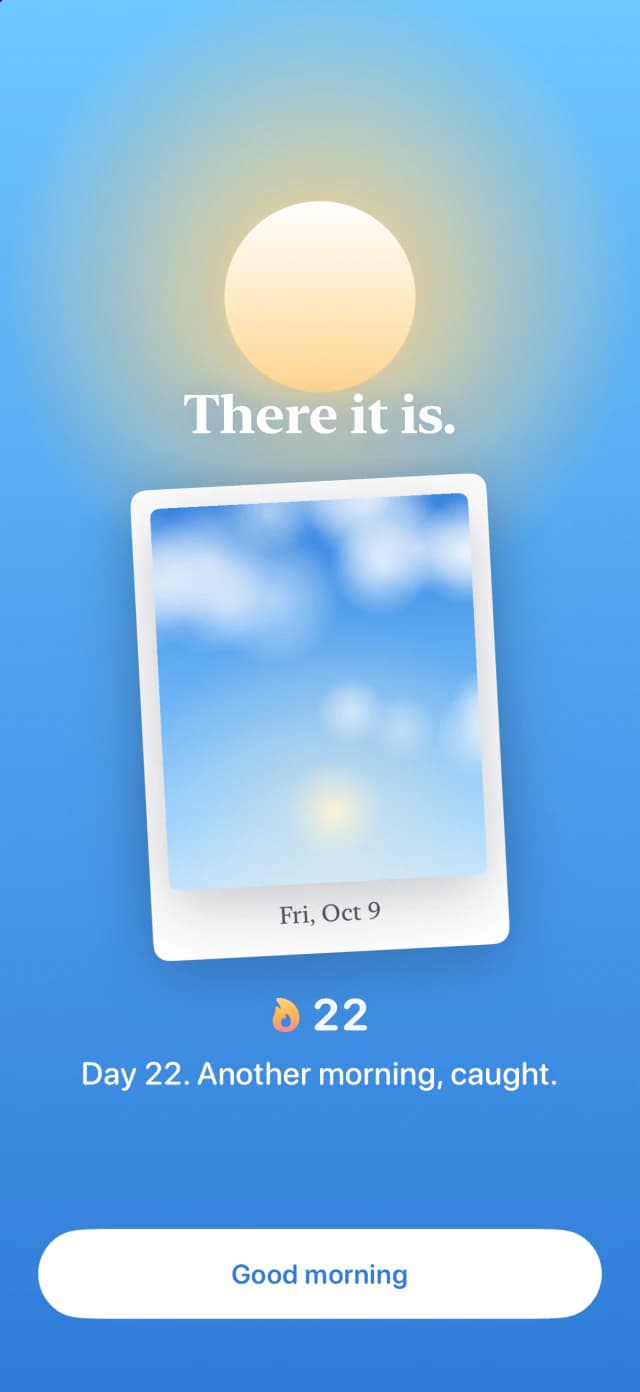
Skyshot turns the first of those into the way you stop your alarm. It rings until your camera sees real sky, so daylight is part of your morning by default. Before sunrise, window mode accepts a window toward the sky. Every morning's sky is kept in your Sky Collage, which makes the habit easy to see.
Further reading
- Blume, Garbazza & Spitschan (2019). Effects of light on human circadian rhythms, sleep and mood. Somnologie.
- Brown et al. (2022). Recommendations for daytime, evening, and nighttime indoor light exposure. PLOS Biology.
- Wright et al. (2013). Entrainment of the human circadian clock to the natural light-dark cycle. Current Biology.
Skyshot is a wellness alarm clock, not a medical device. It doesn't diagnose or treat any condition. Never look directly at the sun.
Questions, answered.
How long should I be outside?
There's no single number. Many recommendations talk about getting outdoor light early in the day; longer helps more on dull days. Skyshot itself only needs a moment.
Does light through a window count?
It helps, but glass and distance reduce it a lot. Outside is better when you can.
Is Skyshot a light therapy device?
No. It's an alarm clock that gets you to the window. It doesn't diagnose or treat any condition.
Keep reading
Sunlight alarm clock
Most sunlight alarm clocks are lamps that fake a sunrise. Skyshot is an iPhone alarm that stops when you show it the real sky, so your morning starts with actual daylight.
Sky Collage
Skyshot saves every morning's sky into a Sky Collage, one tile a day. Here's how the collage works, what Free and Pro keep, and how to share your 30-day poster.
Alarm for heavy sleepers
If you sleep through alarms or switch them off without waking, Skyshot rings through Silent and Focus, follows up with backups at +2, +4 and +6 minutes, and only stands down when you show it the sky.
